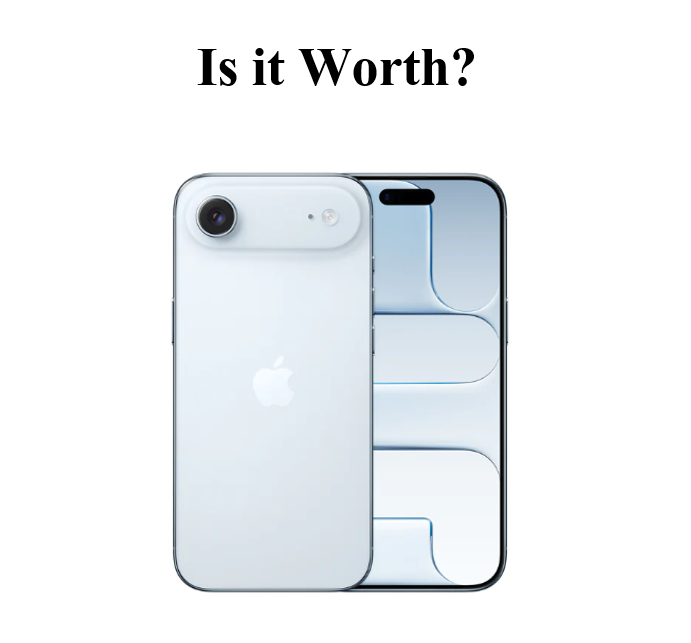

On 9 September 2025, Apple unveiled one of its most anticipated iPhones — the iPhone Air, the slimmest iPhone ever made. This new addition to the iPhone 17 lineup grabbed headlines due to Apple’s long-awaited complete design overhaul, something users hadn’t seen in years.
Priced at ₹1,19,900 (USD 999), the iPhone Air is not only the thinnest iPhone but also one of the lightest, making it extremely comfortable to carry. With its ultra-slim profile and a single rear camera, the design has certainly caught a lot of attention.
To make things clear and simple, I’ve divided this review into four key areas. Based on these points, we’ll decide whether the iPhone Air is actually worth buying.
1. Design & Display
Design is often the first thing people notice when buying a new smartphone, and iPhone Air clearly excels here.
With an incredibly slim 5.6mm thickness and weighing just 165 grams, the iPhone Air is the slimmest and one of the lightest iPhones Apple has ever produced. Despite its thin profile, Apple claims it is highly durable, thanks to a Grade 5 titanium frame.
The display has also been upgraded to a Pro-level experience. The iPhone Air features a 6.5-inch Super Retina XDR display with:
• Up to 3,000 nits peak brightness
• ProMotion technology (up to 120Hz)
• Improved anti-reflection coating
For protection, Apple has paired the titanium frame with Ceramic Shield 2, offering better resistance against scratches and minor drops.
Real-World Experience
In everyday use, the iPhone Air’s display looks stunning and performs on par with the iPhone 17 Pro. After using it for a while, slipping the iPhone Air into your pocket almost feels like you’re carrying nothing at all.
There’s no doubt — iPhone Air is one of the most beautifully designed iPhones Apple has ever made, and its design alone can easily convince many users to buy it.
2. Camera Performance
The iPhone Air comes with a completely redesigned camera layout, featuring a single 48MP Fusion rear camera. While this camera is technically the same as the one used in other iPhone 17 models, it lacks an ultra-wide and telephoto lens.
Rear Camera
For casual photography, the main camera performs well and captures excellent images. However, in certain situations, you will definitely miss the versatility of additional lenses:
• No telephoto lens means limited zoom for wildlife, sports, or portrait shots
• No ultra-wide lens makes it harder to capture landscapes, buildings, or large group photos in tight spaces
Although this is arguably the best single rear camera Apple has ever made, the absence of ultra-wide and telephoto lenses feels like a noticeable compromise at this price point. In scenes with distant subjects or heavy details, the camera also struggles slightly with clarity.
Front Camera
The highlight here is the new 18MP front camera, which is shared across the iPhone 17 lineup. It introduces some genuinely useful improvements:
• Supports Center Stage, keeping you in frame during video calls
• Allows portrait and landscape selfies without rotating the phone
• Enables simultaneous front and rear video recording
In real-world usage, the selfie camera performs exceptionally well, delivering natural skin tones and accurate colors across different lighting conditions.
Camera Verdict
Apple has clearly tried to extract more performance from a single rear camera, but the lack of ultra-wide and telephoto lenses is hard to ignore. While the selfie camera is excellent and feature-rich, photography enthusiasts may find the iPhone Air underwhelming for its price.
3. Battery Life & Charging
Apple measures an iPhone’s battery performance primarily by continuous video playback, and the iPhone Air is rated for up to 27 hours. This is the lowest battery rating in the iPhone 17 lineup, which honestly shouldn’t come as a surprise.
To achieve such an ultra-slim and lightweight design, battery capacity is one of the biggest compromises Apple had to make. The idea was clearly to make the phone feel as light as “Air,” even if it meant sacrificing endurance.
In real-world usage:
• With light to moderate use (browsing, social media, video streaming, calls), the iPhone Air can last a full day
• With heavy usage such as gaming, navigation, music streaming, or extended camera use, you’ll find yourself reaching for the charger more often
Charging Speeds
The iPhone Air supports:
• Fast wired charging: up to 50% in around 30 minutes using a 20W or higher adapter
• Fast wireless charging via Qi2/MagSafe, up to 20W
However, this is where things feel a bit disappointing. Other iPhone 17 models support wireless charging up to 25W, while the iPhone Air is capped at 20W. Considering its premium pricing, this limitation feels unnecessary and slightly unfair.
Battery Verdict
While battery life is not terrible, it is clearly one of the weakest areas of the iPhone Air. The phone works well for casual users, but power users will definitely feel constrained.
4. Performance
The iPhone Air is powered by Apple’s A19 Pro chipset, the same processor used in the iPhone 17 Pro and Pro Max—but with a catch.
Although it carries the “Pro” branding:
• The iPhone Air features a 5-core GPU
• The Pro models come with a 6-core GPU
This means the Pro variants have a clear advantage when it comes to graphics-intensive tasks like high-end gaming and sustained workloads.
Another important difference is cooling. The iPhone Air does not include Apple’s new vapor chamber cooling system, which helps reduce thermal throttling during prolonged heavy usage. As a result, during continuous gaming or demanding tasks, the Pro models maintain performance more consistently.
That said, for everyday usage—apps, multitasking, browsing, video playback—the iPhone Air performs smoothly and reliably, without any noticeable lag.
Performance Verdict
The iPhone Air is powerful enough for most users, but gamers and heavy users will benefit more from the Pro models, which are better optimized for sustained performance.
Final Verdict: Is iPhone Air Worth Buying?
Apple has undeniably done an impressive engineering job with the iPhone Air. Creating a phone this thin and light while still delivering Pro-level performance and an outstanding display is no small achievement.
However, these innovations come with compromises:
• Smaller battery
• Reduced GPU performance
• No vapor chamber cooling
• Single rear camera
• Slower USB 2.0 transfer speeds
• Premium pricing
If you are not a heavy gamer or someone who constantly pushes their phone to its limits, the iPhone Air can be an excellent daily driver—especially if you value design, portability, and display quality above everything else.
For power users, photographers, and gamers, the Pro models remain the better choice. These limitations are also reflected in its declining sales, as many users feel the price doesn’t fully justify the compromises.
Final Opinion
In my opinion, the iPhone Air is a spectacularly engineered smartphone that caters to a very specific audience. It may not be for everyone, but for users with light to moderate usage who prioritize elegance and comfort, it can be a great long-term companion.